Teach children how to think—not only what to learn.
PRITS is a structured thinking-skills programme that helps primary school children analyse situations, explore possibilities, solve problems and express original ideas with confidence.

Every child has a brain full of possibilities.
PRITS gives children practical thinking tools and a safe space to explore more than one answer.
Thinking is a skill—and skills can be developed.
In an AI-driven world, children need more than access to information. They need the judgement to question it, the creativity to build on it and the confidence to contribute their own ideas.
Help children learn how to think.
Watch this introduction to the importance of developing thinking skills in children. PRITS gives learners opportunities to ask questions, explore ideas and explain their reasoning.
Stronger thinkers in school and beyond.
Every activity encourages children to observe, connect, question, explain and improve their thinking.
Problem-solving skills
Break down challenges and consider more than one possible solution.
Creative answers
Move beyond the most obvious response and generate original ideas.
Curiosity
Ask better questions and become more eager to investigate possibilities.
Perspective-taking
Listen to other learners and discover different ways of seeing the same issue.
Scenario evaluation
Study pictures and real-life situations before reaching a conclusion.
Pattern recognition
Notice similarities, differences and relationships in IQ-style questions.
Five components for confident, independent learners.
PRITS 2.0 develops more than thinking skills. Its structured activities help children prepare to learn, explore ideas, build positive study habits, strengthen recall and coordinate movement with attention.
Finger Exercises
Simple finger patterns, coordinated hand movements and short warm-up routines help children move calmly from playtime into learning time. As challenges progress, children practise attention, fine-motor coordination and following instructions.
Think+ Discovery Tasks
Children explore puzzles, situations and open-ended questions through observation, comparison, pattern recognition, reasoning and creative problem-solving. Teachers encourage them to explain how they reached an answer and discover another possible way.
Study Habits
Children practise preparing materials, listening attentively, managing distractions, completing tasks step by step, checking their work and correcting mistakes. Repeated practice helps useful routines become positive learning habits.
Remember-it Challenges
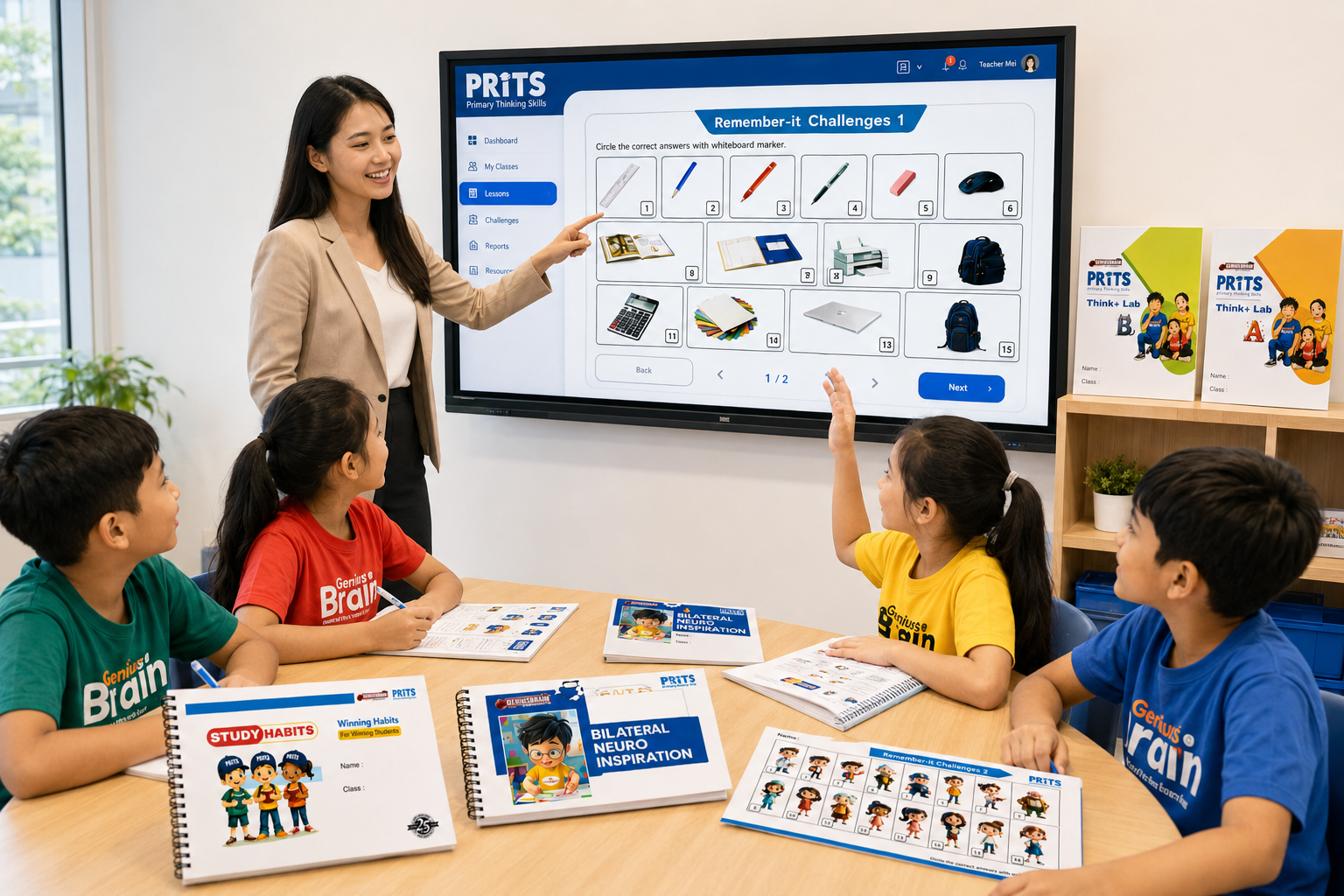
Progressive visual, picture, sequence, number, word and object-recall activities teach children to notice, organise and retrieve information. The simple process is: Look → Observe → Remember → Hide → Recall.
Bilateral Neuro Inspiration
Two-hand, alternating, mirror and left–right coordination activities challenge children to manage movement while maintaining attention, following patterns and processing instructions.
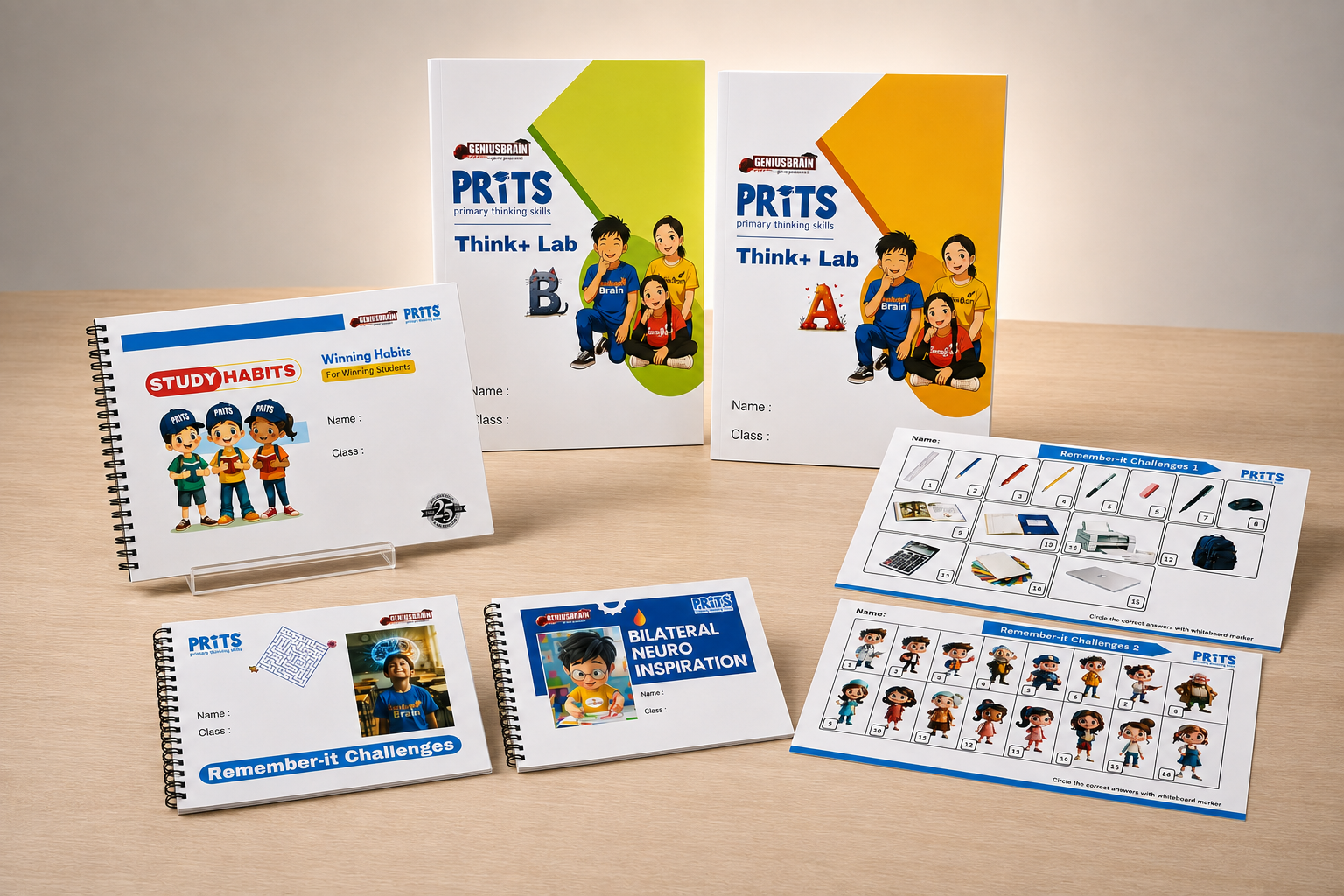
PRITS Innovative Learning Materials
Purpose-designed books, challenges and reusable activities turn thinking into something children can see, discuss and practise. Each resource supports a different part of the PRITS learning journey.
Thinking becomes visible when children share.
Facilitated discussion helps learners compare ideas, explain their reasoning and discover that one question can have many thoughtful answers.